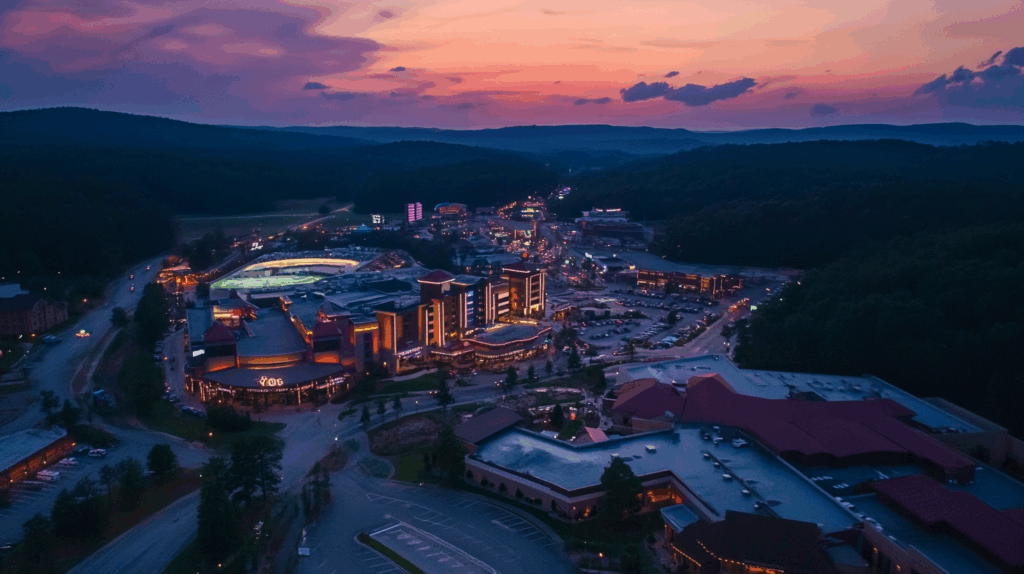

Cherokee defies expectations: a Smoky Mountains town where visitors snap photos of waterfalls and browse handmade crafts by day. At the same time, Harrah’s Cherokee Casino Resort lights up the night, drawing crowds with the promise of jackpots.
There are no billion-dollar mega-residents like in Vegas, and no celebrity chefs slinging overpriced steaks. Instead, Cherokee offers something better: opportunity without the frenzy. While tourists feed slot machines and are attracted to the mountain trails, the shrewdest players are building equity: one acre, one rental property, one strategic deal at a time.
Tribal Gaming Enhances Economic Transformation
When Harrah’s Cherokee Casino Resort opened its doors in 1997 under the Eastern Band of Cherokee Indians’ operation, it became North Carolina’s pioneering gaming destination [1]. Gambling was already permitted on tribal land since 1988, but this move flipped the switch. Surprisingly, despite generating $105 million in the first year in taxes, online sports betting in North Carolina was legalised and launched only in 2024.
Overnight, Cherokee morphed from a sleepy mountain gateway into a tourism powerhouse, becoming one of the economic drivers for the region. Jackson County, celebrated for its breathtaking landscapes, cascading waterfalls, and hiking paths, attracted nearly 1 million tourists by 2022, generating $119 million in local economic impact, with the casino doing its part of the job [2]. Today, it’s the heartbeat of a town that thrives on visitor dollars.
Tourism-Driven Property Market Dynamics
That tourism surge is Cherokee’s golden ticket, driving a hot property market. Short-term rentals near the casino and vacation homes by the Great Smoky Mountains trails are in high demand [3]. While tribal lands remain off-market, neighboring areas in Jackson County now show a $440,000 median home price, approaching Asheville’s $480,000 benchmark [4][5]. Investors capitalize on two key drivers: consistent rental demand from annual Smokies visitors, casino traffic, and long-term appreciation as regional development accelerates.
The market carries calculated risks: occupancy rates fluctuate seasonally, and interest rate sensitivity impacts buyer pools. However, strategic investors find the risk-reward equation compelling, particularly for properties within 15 minutes of casino corridors.
Investment Strategies for the NC Market
Want in? Here’s your strategy. Snap up cabins or condos near the casino or in scenic Jackson County, which are prime spots for renters. Time your buy for the off-season when prices dip, or eye up-and-coming areas near new developments. Homes move fast, selling in about 50 days, indicating solid demand [6]. With visitor spending topping $452 million in 2022 [2], diversify your portfolio, blend short-term tourist rentals with long-term leases for casino workers. Play it smart, and the returns could stack up.
Cherokee’s Future: Your Call
Cherokee’s story has transformed from tribal heritage to a gambling hub, now a real estate contender. The seasonal fluctuations require careful navigation, but the fundamentals of limited inventory, sustained visitor spending, and regional development position Jackson County as a market where disciplined investors can build lasting equity. In Cherokee’s high-stakes growth story, the smart money isn’t on fleeting luck, but on calculated plays anchored in tourism’s unwavering momentum.
Sources
-
- Caesars Entertainment. “Harrah’s Cherokee Hotel & Casino Resort – North Carolina,”
- The Southern Scoop News. “Jackson County reports 3.5% increase in visitor spending,”
- EDPNC. “North Carolina Breaks Tourism Spending Record in 2023,”
- Zillow. “Jackson County, NC Housing Market,”
- Zillow. “Asheville, NC Housing Market,”
- Redfin. “Jackson County, NC Housing Market,”