
Where Glamour Once Rolled the Dice
The Hacienda once stood as a beacon of mid-century glamour, its neon-lit facade drawing gamblers to the Las Vegas Strip. Where chips clinked and dice rolled, a new marvel now rises: Mandalay Bay, a sprawling resort that traded the Hacienda’s vintage charm for tropical luxury. This transformation wasn’t just a demolition, but a high-stakes wager on the Strip’s future. The Hacienda’s legacy lives on, not in its walls, but in the Neon Museum, whose iconic Horse and Rider sign now glows as a relic of Vegas’s golden era [1]. Mandalay Bay, meanwhile, deals a fresh hand of modern indulgence.
A Bold Bet on Reinvention
The journey from the Hacienda to Mandalay Bay was a masterstroke of vision and grit. The Hacienda, a Strip staple for decades, had grown tired, its charm fading amid newer rivals. Demolishing it was no small feat: the implosion required precision to clear the site for a resort nearly triple its size [2]. Zoning battles loomed, but developers navigated the maze with a clear goal: a resort that would redefine luxury.
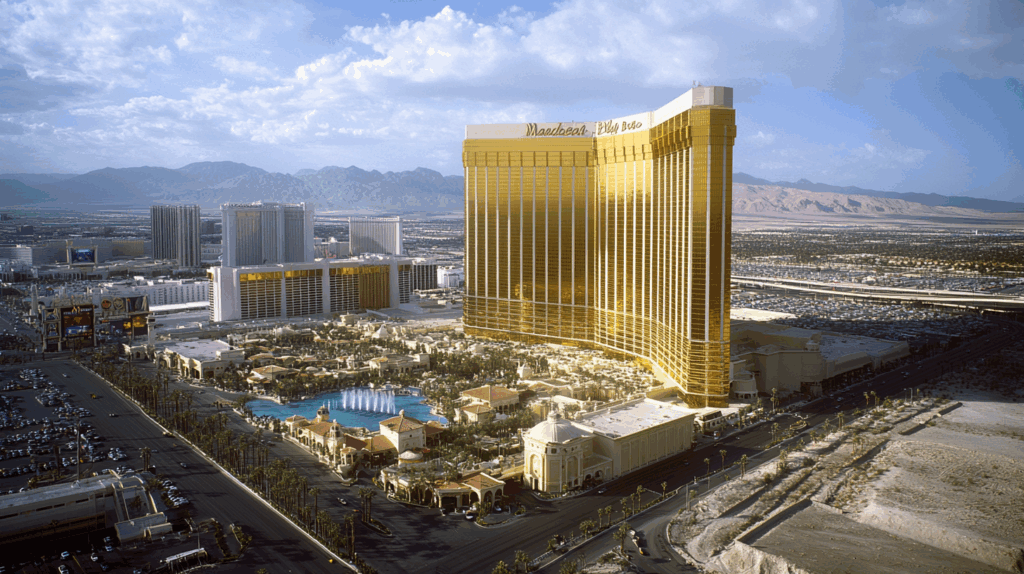
Mandalay Bay’s design, built in place of Hacienda, is a triumph of imagination. Its tropical theme, complete with an 11-acre lagoon and sandy beach, broke the Strip’s mold. The property’s massive meeting venues, some of the World’s most capacious, established fresh benchmarks for business travelers [3]. Rather than simple reconstruction, this visionary overhaul converted an obsolete casino into a diversified hub where recreation, enterprise, and the arts converge.
Raising the Stakes on the Strip
Mandalay Bay’s arrival reshuffled the deck for Las Vegas. The resort’s opening injected life into the south Strip, drawing tourists and conventioners alike. Its vast meeting spaces fueled a boom in business events, creating jobs and lifting local commerce [4]. Property values soared as the area transformed from a quiet corner into a bustling hub. For investors, it was a lesson in the power of prime real estate: even faded icons can be reborn as revenue engines. Mandalay Bay’s success also sparked a trend, proving that mixed-use resorts could thrive on the Strip, blending gaming with hospitality and retail. This conversion didn’t just build a resort, it built a blueprint for the city’s future.
Playing the Long Game
The Hacienda’s reinvention offers a jackpot of insights:
- Bet Big on Vision: Prime land demands bold ideas, not quick fixes.
- Diversify the Hand: Mixed-use spaces attract diverse revenue streams.
- Honor the Past: Preserving relics, like the Hacienda’s neon sign, adds cultural cachet [1].
These lessons are a playbook for developers and investors, showing how to turn aging properties into thriving destinations. Mandalay Bay reshaped the Strip’s skyline and economic pulse by folding the old and dealing with the new.
From Slots to Sand
The Hacienda’s legacy of neon and high rollers now underpins a resort where waves lap and conventioneers gather. Beyond a development triumph, this change demonstrates Las Vegas’ perpetual ability to transform. As the Strip evolves, the story of Mandalay Bay invites us to ponder: what other relics might rise again, trading one dream for another? Real estate’s grandest prizes usually await those brave enough to reimagine former gaming houses as future showpieces.
Sources
- Neon Museum. “History of the Demolished Hotels in Las Vegas,”
- KSNV. “Hacienda Hotel makes way for Mandalay Bay – KSNV,”
- Mandalay Bay. “Meeting & Convention Facilities,”
- Los Angeles Times. “Vegas’ Tourism Boom Now a Hard-Luck Story”
Disclaimer: This analysis is for informational purposes only and does not constitute financial, legal, or investment advice. Readers should conduct their due diligence and consult qualified professionals before making any real estate decisions.